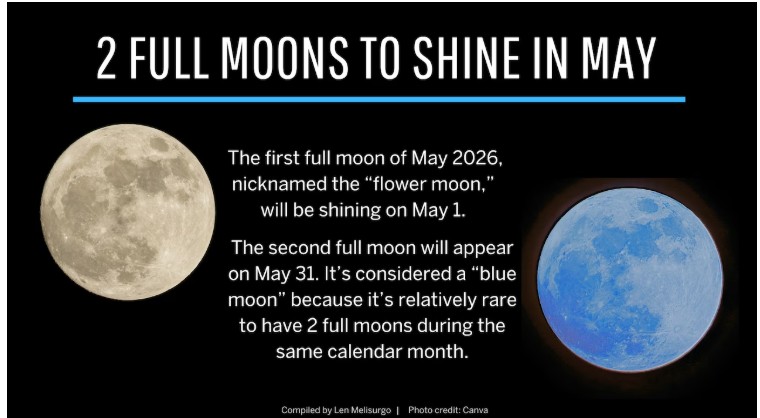
As late spring settles across the northern hemisphere, the night sky prepares for a brilliant display. On the final night of May 2026, the sky will brighten with the intense glow of the Full Moon May 2026. This lunar phase, widely known as the Flower Moon, shines at a time when gardens and fields burst with color. The event draws interest from casual sky-watchers and experienced stargazers alike. It holds a unique spot in the lunar calendar because it coincides with the peak of spring growth. This article covers the science, the history, and the best ways to observe this light-filled event.
Decoding the Full Moon in May 2026: Astronomical Specifications
Understanding this lunar event requires a look at the precise orbital data. The moon does not just appear; it follows a predictable, clockwork path around our planet. This section provides the technical details you need to track the peak moment of the Full Moon May 2026.
Exact Peak Illumination Time and Date
The moon reaches its peak illumination on May 31, 2026. At this moment, it sits directly opposite the sun in the sky. For viewers in the Eastern Time zone, this peak occurs in the early morning hours. If you are watching from Greenwich Mean Time, the precise moment is roughly 11:45 UTC. The moon will appear 100% illuminated at this exact peak, though it looks fully round to the naked eye for about two days.
Constellation Placement and Visibility
During the peak of the Full Moon May 2026, the moon will traverse the constellation of Scorpius. This zodiac position places it relatively low in the sky for many Northern Hemisphere observers. If you live in the Southern Hemisphere, the moon will appear much higher in the sky during the night. You should check a local stargazing app to find the exact rise and set times for your specific city. These times change depending on your longitude and latitude.
Size and Brightness Context
The apparent size of the moon changes throughout the year as its distance from Earth shifts. In late May 2026, the moon is not at its closest point to Earth, so it will not qualify as a supermoon. However, its brightness remains powerful due to the angle of the sun. The full moon often shines with a high apparent magnitude, which can cast visible shadows on the ground. Its glow will wash out fainter stars in the immediate area of the sky.
The Cultural Heritage of the Flower Moon
The name Flower Moon belongs to a tradition of tracking time through the natural world. Many cultures gave names to each full moon to keep records of the seasons. This practice helped early societies know when to hunt, plant, or prepare for winter.
Indigenous American Naming Traditions
The name Flower Moon comes from the Algonquin peoples of North America. They observed that late May brought a surge of blooming flowers across their territories. This name provided a reliable way to know that the danger of frost had passed. Other crews used names like the Budding Moon or the Planting Moon. These names reflect the close tie between their daily survival and the cycles of the moon.
Global Equivalents and Folklore
Different parts of the world have their own names for the May full moon. In Europe, many cultures called it the Milk Moon. This name originated from the time when cows were moved to summer pastures to graze on fresh grass. Some traditions also called it the Hare Moon because young hares were active in the fields during this season. These names highlight how different environments shaped the way people saw the same moon.
The Flower Moon in Modern Astrology
Astrology sees the full moon as a time for results and emotional clarity. When a full moon occurs in a sign like Scorpio, many believe it highlights issues of trust and transformation. Some people use this time to release habits that no longer help them. Regardless of your beliefs, the full moon acts as a natural reminder to pause and check in with your own goals and feelings.
Maximizing Your Viewing Experience: Tips for May 2026
Observing the full moon is simple, but a few steps can improve the experience. You do not need expensive equipment to enjoy this event. Preparation helps you get the best view of the lunar surface.
Location Scouting: Beating Light Pollution
City lights often hide the true detail of the moon, even during a full phase. To see the moon clearly, travel away from urban centers to a darker spot. Websites that map light pollution can show you areas where the sky remains dark. A local park or a quiet country road can work well for your viewing location.
Essential Gear for Moon Gazing
You can see the moon perfectly well without any tools. However, binoculars offer a better look at the craters and shadows. A pair of 7×50 binoculars is ideal because they are easy to hold steady. If you want to take photos, a camera with a manual mode is necessary. Set your camera to a low ISO and a fast shutter speed to keep the moon sharp. Use a sturdy tripod to avoid blurry images caused by hand movement.
Timing Your Observation for Maximum Impact
The best time to see the moon is often during moonrise. As the moon sits near the horizon, the atmosphere makes it appear larger and warmer in color. This phenomenon is known as the moon illusion. Seeing the massive, golden disk rise over the horizon is a powerful sight that cameras rarely capture well. Plan to be outside during the exact time of moonrise for your location.
Lunar Events Coinciding with May 2026
The full moon does not exist in isolation. Other objects in space often appear nearby, adding to the beauty of the night. May 2026 offers a few celestial highlights that complement the main event.
Visibility of Planets Near the Full Moon
On the night of the full moon, look for bright points of light nearby. Planets like Saturn may be visible in the early hours before the moon rises. These planets do not twinkle like stars, which helps you identify them. Check a star map to see if any planets have moved into the same patch of sky as the moon on May 31. A conjunction, where the moon and a planet appear close, can be a stunning view through small binoculars.
Meteor Shower Correlation
Meteor showers happen when Earth passes through debris left by comets. The brightness of a full moon usually makes it hard to see meteors. Most faint shooting stars vanish in the intense lunar light. If a minor meteor shower is active, focus your efforts on the nights just before the moon becomes fully full. You will have a better chance of spotting activity when the sky is slightly darker.
Related: June 2026 Love Horoscope
Final Thoughts
The Full Moon May 2026 serves as a bright signal of the transition into early summer. It carries the weight of history through its many cultural names and offers a great excuse to step outside. Whether you are interested in the mechanics of the moon or the folklore that surrounds it, this event offers something for everyone. Take time on the night of May 31 to look up and appreciate the cycle of the sky. Pause for a moment to watch the light change the world around you, marking the end of a spring month and the start of a new season.